
The World Works Better With Us: What Inclusive Design Actually Means.

Quick take
- Disability isn’t a flaw in a person. It’s what happens when something gets designed without them in mind, which is close to how the World Health Organization itself now defines it.
- The same barrier usually shows up for three different groups: people who face it permanently, temporarily, or only in certain situations.
- Fix it for the permanent case, like curb cuts built for wheelchair users, and the temporary and situational versions of the same barrier are usually already solved. The value compounds.
- For municipalities, school districts, and other organizations, this looks like: a resident using a screen reader, a staff member typing one-handed after an injury, a parent filling out a form at a stoplight. Same barrier, same fix.
- Title II of the ADA sets a deadline. It isn’t the reason to do this work, access for the people you serve is.
None of it is an accident
A hotel door that slides open on its own. A train platform where the next arrival scrolls across a screen instead of only crackling through a speaker. A phone call that gets you to the right person the moment you say what you need.
None of that happened by accident. Every one of those is a design decision, and so is every door that doesn’t slide, every platform that only announces over a speaker, and every phone tree that makes you guess. Disability Pride Month’s 2026 theme, The World Works Better With Us, is really a claim about that: we build the world, and what we build decides who it works for.
Disability, redefined
That’s worth sitting with, because it flips a common assumption. The usual instinct is to think of disability as something that lives inside a person, a condition, a limitation, something to work around.
The World Health Organization used to define it close to that way too. Its 1980 classification described disability largely as a restriction or lack of ability belonging to the individual, a straight consequence of an impairment.
WHO changed that in 2001. The updated framework describes disability and functioning as, in the organization’s own words, “outcomes of interactions between health conditions… and contextual factors,” not the health condition on its own.
That’s a more careful way of saying what inclusive design has been arguing for years: exclusion isn’t a property of the person who runs into it. It’s a property of the thing that was built. A step is only a barrier because someone built stairs instead of a ramp. A form is only unusable because someone built it assuming everyone can see a screen, hold a mouse, and read English fluently. Change the design, and the same person isn’t excluded by it anymore. The exclusion was never in them. It was in what got built around them.
Permanent, temporary, situational
There’s a practical way to apply this, sometimes called the persona spectrum, a way of thinking that a number of inclusive design practitioners have helped formalize over the years, Kat Holmes among them during her time leading Microsoft’s Inclusive Design Toolkit team. (Her book Mismatch is a good next read if you want to go deeper on where this thinking got formalized.) It asks you to look at any barrier from three angles at once: who experiences it permanently, who experiences it temporarily, and who experiences it only in certain situations.
Curb cuts are the clearest example, and they predate all of this by decades. The first known ones went into Kalamazoo, Michigan, in 1945, and a disabled veteran and lawyer named Jack Fisher was among the first to celebrate them. Disability activists in Berkeley picked up the fight in the 1970s, in some cases pouring curb ramps themselves at night when the city wouldn’t.
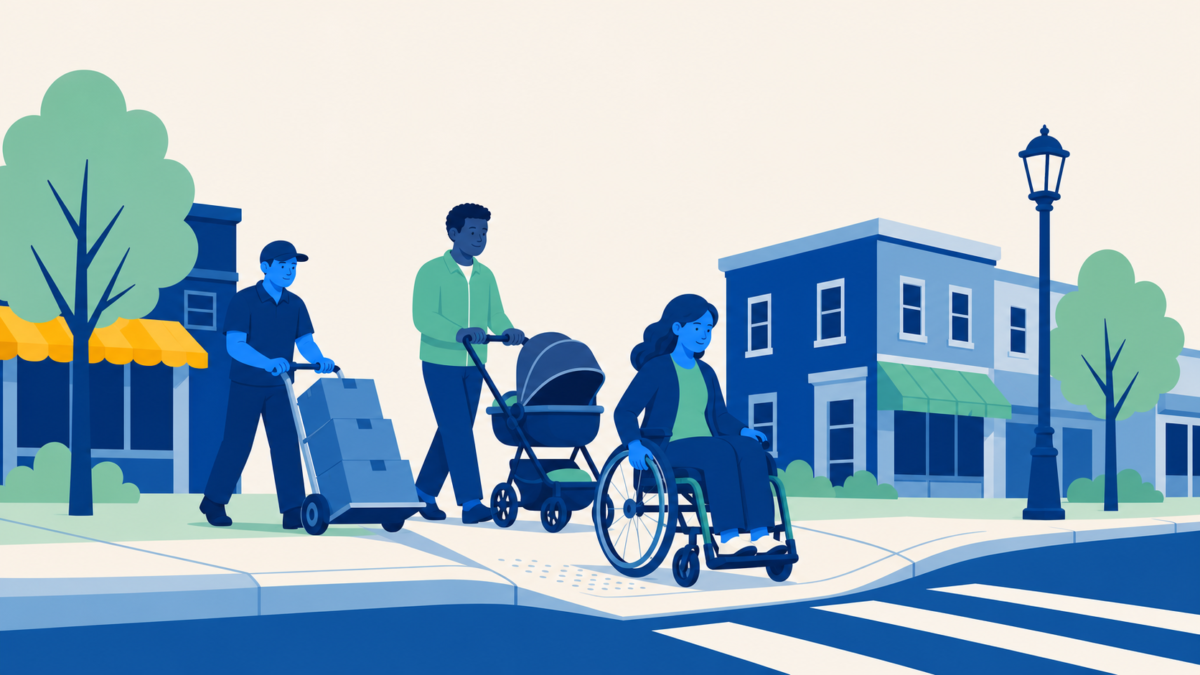
Those ramps were built for wheelchair users, permanently. But they also work for a parent pushing a stroller, situationally, and for a delivery driver with a hand truck, most days. One decision, three completely different reasons someone needed it, and the same fix covers all three.
That’s the actual mechanism, not a slogan. Fix the permanent case and the temporary and situational versions of the same barrier are usually already solved along with it. The value compounds. It doesn’t stop at the group you built it for.
What this looks like for the people you serve
Take a municipality for example.
- A resident using a screen reader to get through a meeting agenda is the permanent case.
- A staff member typing with one hand after a wrist injury is the temporary one.
- A parent filling out a school form on a cracked phone screen is the situational one.
Same barrier, same fix, whether you’re a municipality, a school district, or any other organization putting a service online.
This is also where Title II of the ADA fits in, and where we’re careful about the order we say things in. The deadline is when enforcement of WCAG 2.1 AA starts. It isn’t the reason to do this work. Access for the people you serve is the reason. The law just puts a clock on it.
Where to start
If you’ve already started this work, keep going. If you haven’t, this is a real place to begin.
Get in touch with the Dirigo Interactive team, whatever that looks like for you right now. Training so your own staff can start catching these gaps themselves. Help with inclusive design, web content, and document publishing specifically. The web and design work itself, end to end. Or just an honest read on where you actually stand today, a needs assessment, before you decide anything else. All of it starts as a conversation.
When has a design choice, yours or someone else’s, changed your day? Maybe it left you out. Maybe it made something finally click. Either way, that’s worth noticing, and it’s worth building on purpose.